Trip Report: Kiribati
Visited in August 2025
This trip report is part of a four-part series. This is the second part and for a better understanding it is worth starting with the first article and going through the blog posts in chronological order.
Kiribati was my second stop on my fourth and final trip through Oceania. At least the final trip before I finish my road to 197. On this trip, I visited the four remaining countries in Micronesia, a region in the Pacific north of Melanesia and Polynesia.
Kiribati covers only about 811 km² of land, which is roughly the size of Hamburg or New York City, spread across several islands in the Central Pacific. However, the national territory extends over an ocean area almost as large as India and is located on three island groups (Gilbert, Phoenix, and Line Islands). This makes it one of the most scattered countries in the world and the only one located in all four hemispheres.
Around 120,000 people live in the country. Most of them live on the main island of Tarawa. Kiribati is also one of the countries most threatened by climate change – rising sea levels could make many islands uninhabitable in the long term. The highest point in the country is only 3 meters above sea level.
Kiribati is pronounced “Kiri-bas”, by the way. In the Gilbertese language, ‘ti’ stands for “s.” So how is Kiritimati Island, which belongs to the country, pronounced? That’s right, Christmas Island.
I had four days in Kiribati, which I found to be a very long time. The reason for this was that there is a weekly flight from Kiribati to Marshall Islands, my next destination, and I had the choice of arriving in Kiribati either four days or one day in advance. However, arriving just one day in advance would have been risky. If this flight had been canceled for any reason, I would have had to wait another week for my flight to Marshall Islands.
So I played it safe, even though I felt four days was too long. At least, this gave me the opportunity to see Abaiang, another island in the country, in addition to the main island of Tarawa. Until now, I have mostly only seen the main islands of the countries in the Pacific.
Day 1: South Tarawa – Betio
My flight from Nadi (Fiji) landed in Tarawa in the morning. Entry was relatively straightforward: a few questions from immigration about whether I knew anyone and whether it was my first visit to Kiribati, then I was able to pass through. In front of the terminal, I bought a SIM card from Oceanlink for $1 + 8 GB of data for $10. Then I was met by the driver from the George Hotel, where I was to spend the next night.
Tarawa is a relatively large atoll. The drive from the airport to Betio, the island at the southwestern tip of the atoll, took over an hour. There is a single main road that runs like a narrow thread through the atoll. On the right-hand side, often only a few meters away, the open Pacific Ocean rushes against the white coral sand.
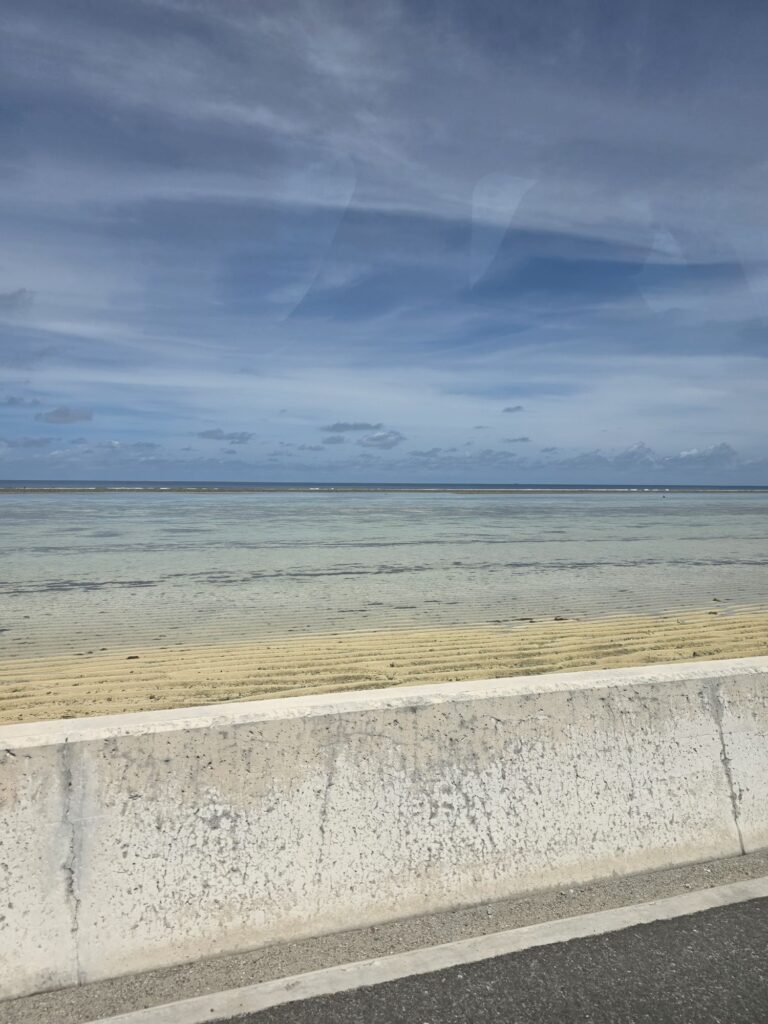
On the left, you can see the lagoon – calm, shallow, often with boats lying in the water. Depending on the sun, the water ranges in color from light turquoise to deep blue.
Betio – do you remember how to pronounce it correctly? – is one of the most densely populated islands I have seen in the Pacific. Nearly 20,000 people live here in a small area. Betio is also home to the country’s main port.
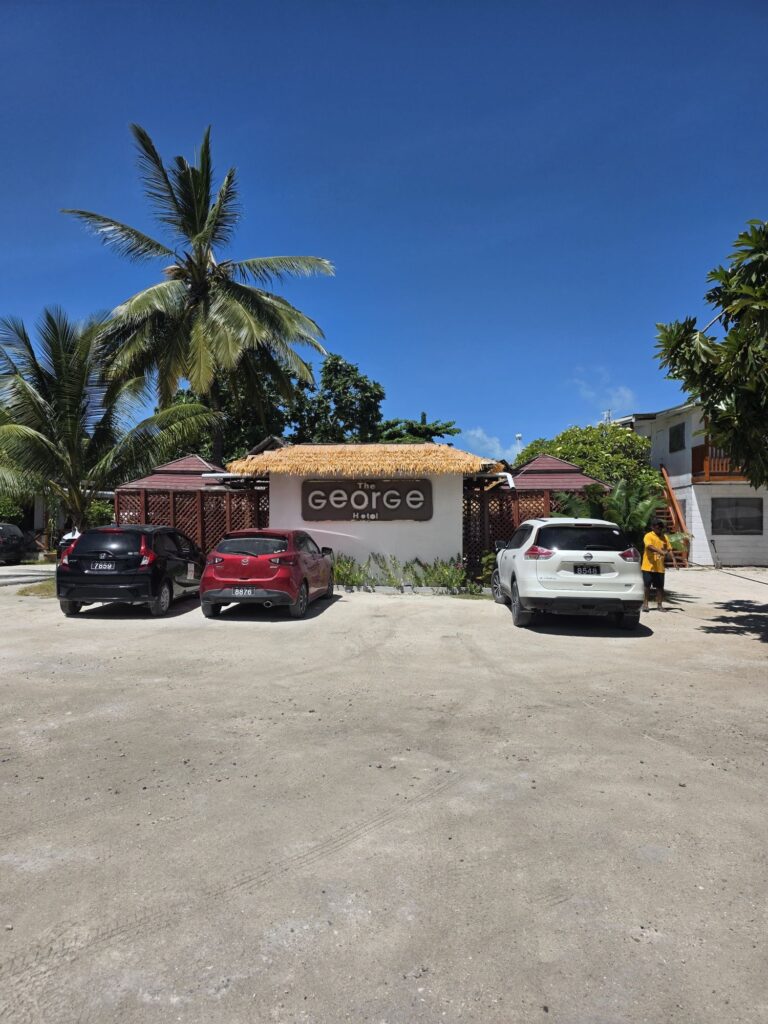
In Tarawa, I had the same problem as in Nauru. All the hotels were either fully booked or didn’t respond to me – with the exception of the George Hotel. The George Hotel is a no-frills hotel with bare rooms where cockroaches sometimes run across the floor. Certainly not a beautiful hotel, but probably one of the most presentable in Kiribati, I guess.
Tarawa is best known for the Battle of Tarawa during World War II. The Japanese built a heavily fortified defense system on Betio, which was captured by US troops in an invasion that resulted in heavy casualties. Many remnants of bunkers, coastal cannons, and monuments are still visible today.
Since I still had the whole afternoon ahead of me, I booked a tour with Molly, who is famous on the island for her World War II tours. A full-day tour costs AUD 120 (Kiribati does not have its own currency and uses the Australian dollar). The lady charged me the same for a half-day tour.
Molly picked me up from the George Hotel and drove me around Betio in her car. The rusty weapons and bunkers are scattered all over Betio. Some of the bunkers are located in the middle of residential areas, practically in the gardens of houses. The weapons, on the other hand, are located on the coast.
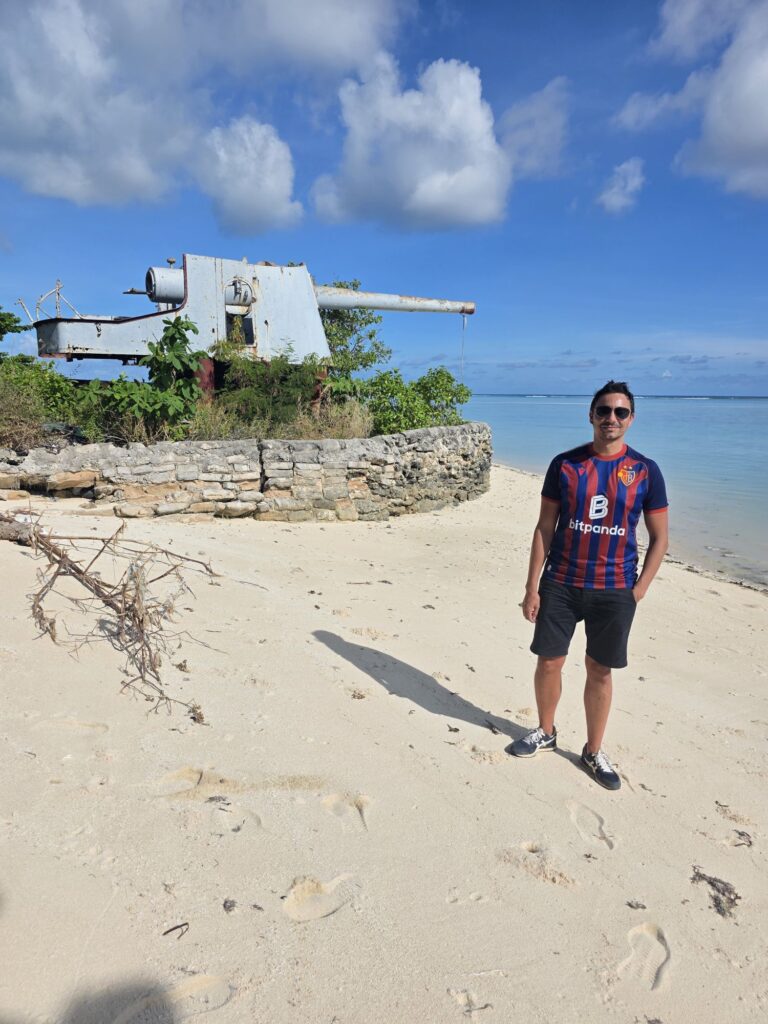
Molly explained a few things to me, although I must admit that I didn’t understand everything. The dialect in Kiribati was the most difficult for me in the Pacific so far, and I also had the feeling that fewer people spoke English than on the other islands.
In addition to all the WW2 relics, I also got an impression of the island. And to be honest, it wasn’t particularly positive. Betio seemed dirty, undeveloped and felt like it had more dogs than people. According to Molly, the dogs are dangerous and she recommends walking around with a stick or stones to defend yourself against the dogs in case of an attack.
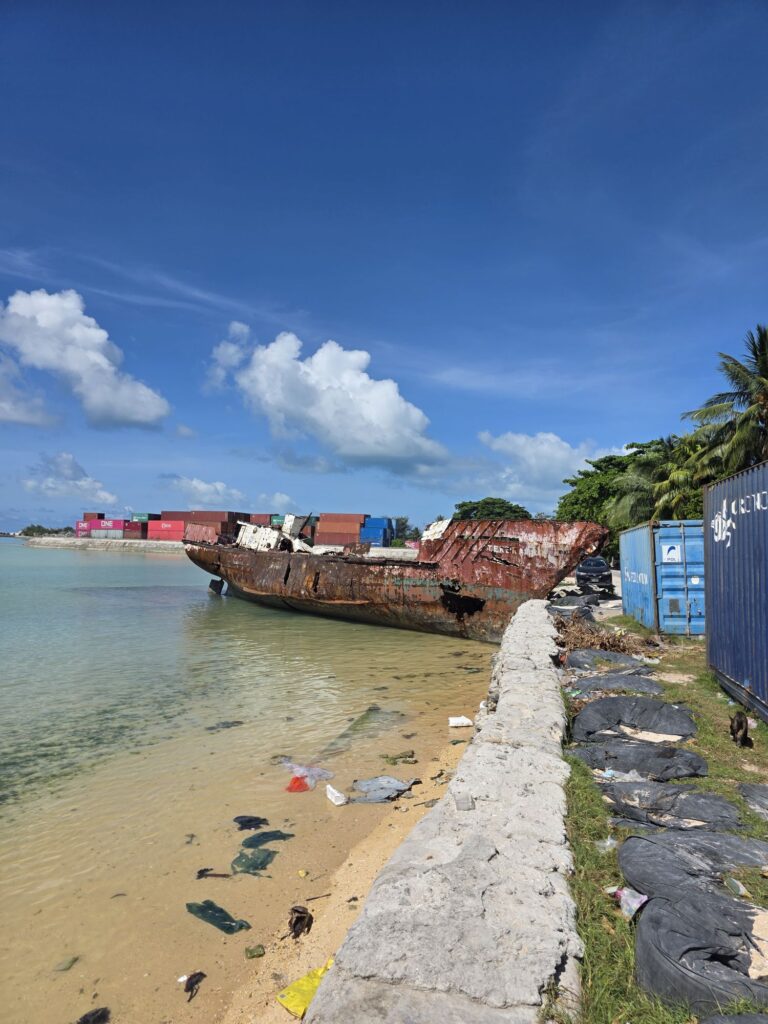
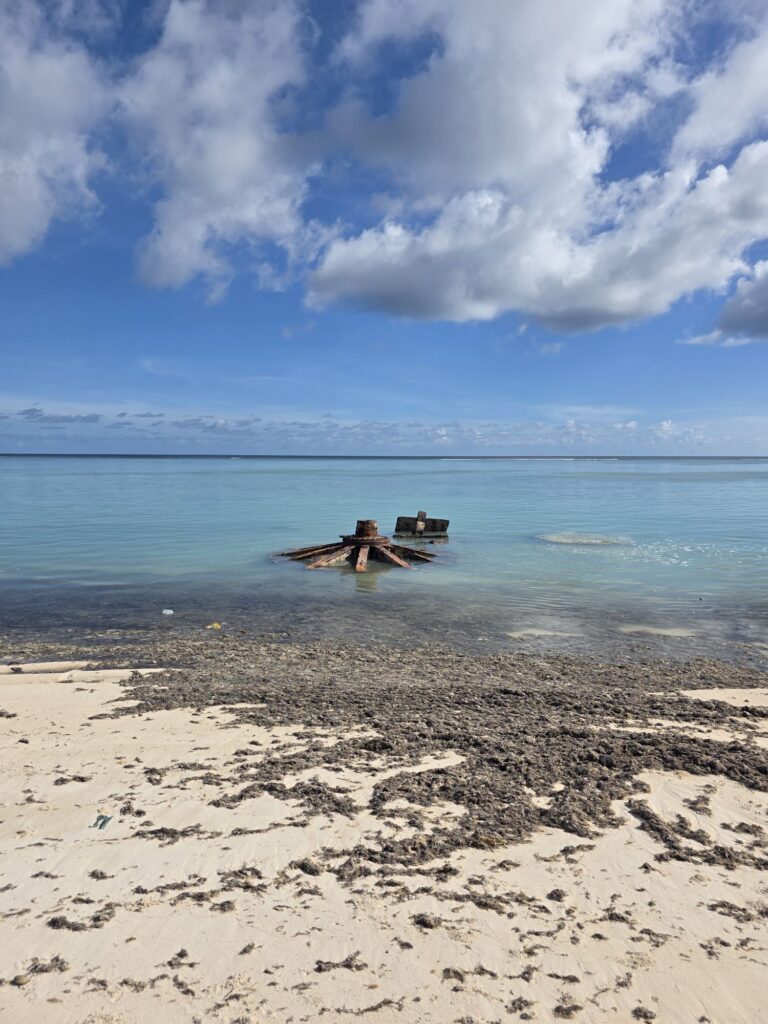
The water in Tarawa looked much nicer than in this picture in most places. Typical light blue, turquoise water right next to the road, but appearances can be deceiving. Apparently, the locals use the lagoon as a toilet. Some travelers even confirmed to me that they saw people walking knee-deep into the water to defecate. Therefore, you should refrain from swimming in the waters of Tarawa.
The tour was over after about two hours, after we had visited all the WW2 relics. The tour was okaish. Molly was nice, but she turned out to be more of a taxi driver who drove me to the relics and then told me to get out and look at them on my own. Not that I regret the tour, I probably wouldn’t have had anything better to do that afternoon anyway, but it wasn’t great either.
All in all, my impression of Kiribati after this first day was not the best. I know my last paragraphs sound very, very negative, but Betio was somehow not a place where I felt comfortable. Fortunately, my stay was only for one day and I was able to continue my journey the next day…
Day 2 + 3: Abaiang
About a two-hour boat ride from Tarawa lies Abaiang, a so-called outer island. This term is used in the Pacific region for islands outside the main atoll or the capital region.
I had never heard of this place before I booked my flights to the Pacific. Abaiang was recommended to me by another traveler who described the island as one of the highlights of the entire Pacific. With my four days, which were basically too many for Tarawa, I had enough time to make a two-day detour to the neighboring island.
The boat was supposed to leave the port of Betio at 6 am In fact, we didn’t leave until around 7 am, which was apparently still quite punctual by Kiribati time. Depending on the tide, it can also be significantly later before the boat leaves.
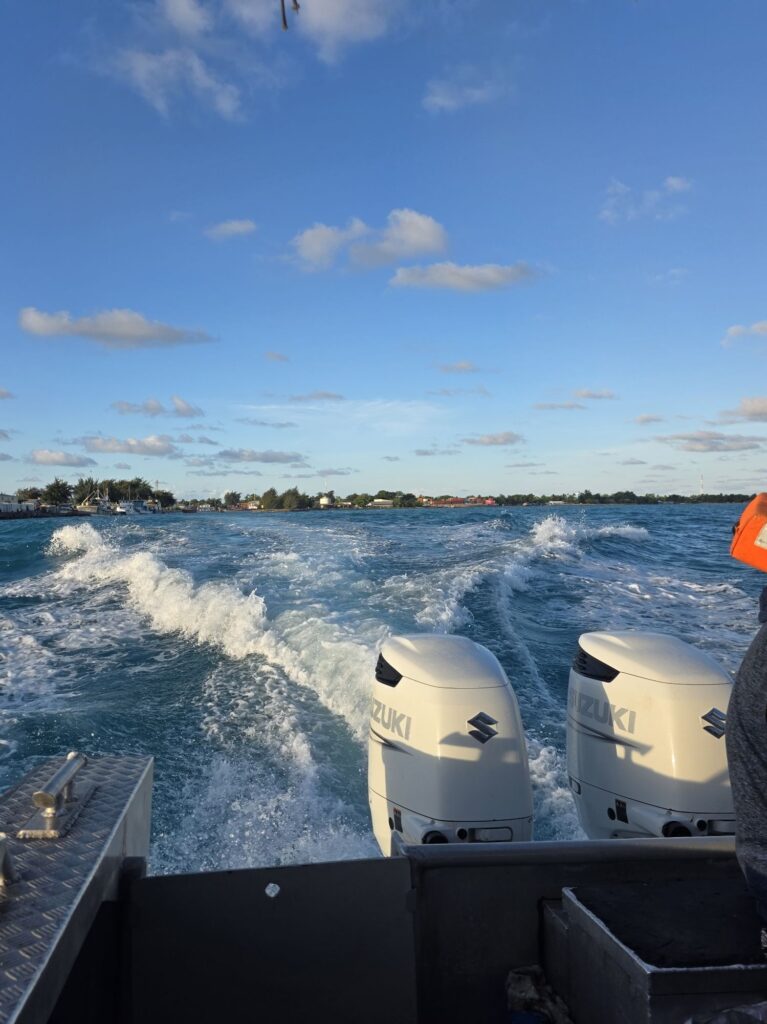
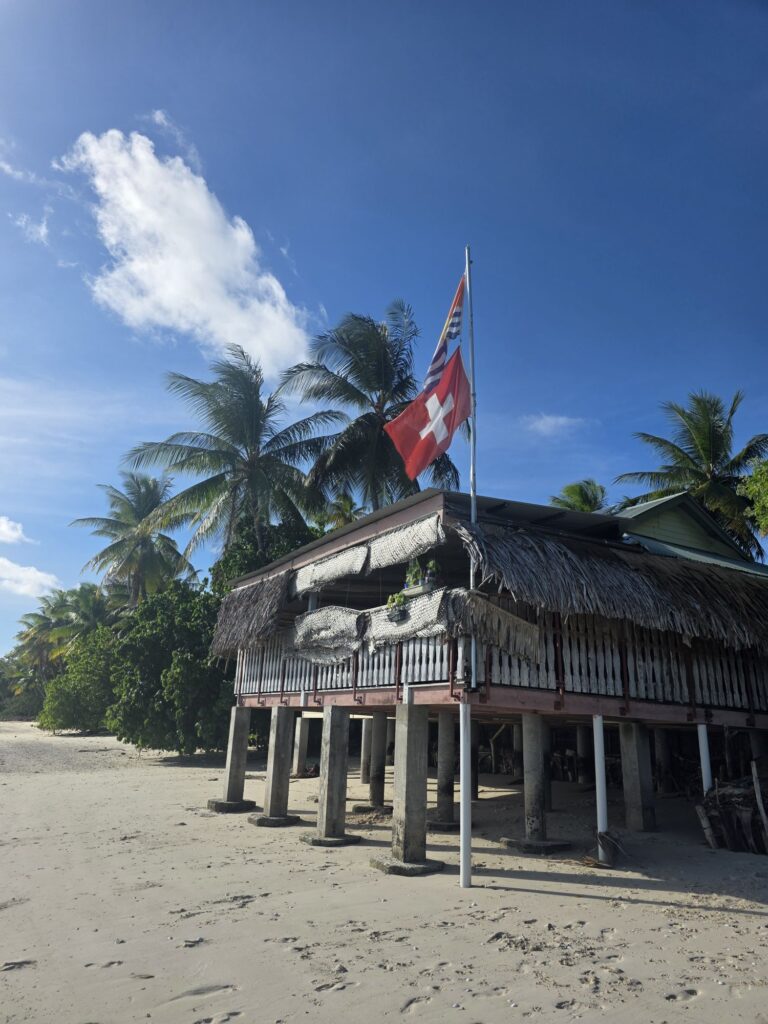
Two hours later, I was in Abaiang, where I was greeted by Nick. Nick is Swiss, just like me, and emigrated to Kiribati a few years ago, where he lives with his wife Lisa, who is from Kiribati. He runs a small guesthouse on Abaiang, the KiriSwiss Residence, where he occasionally accommodates travelers. Nick also booked the speedboat tickets for me (70 AUD return).
Funnily enough, Nick had another guest from Switzerland staying with him who, like me, came from Basel (or rather Riehen, right next to the city). André works for the WHO in Kiribati. So the KiriSwiss Residence was a real Swiss gathering place over the next few days.
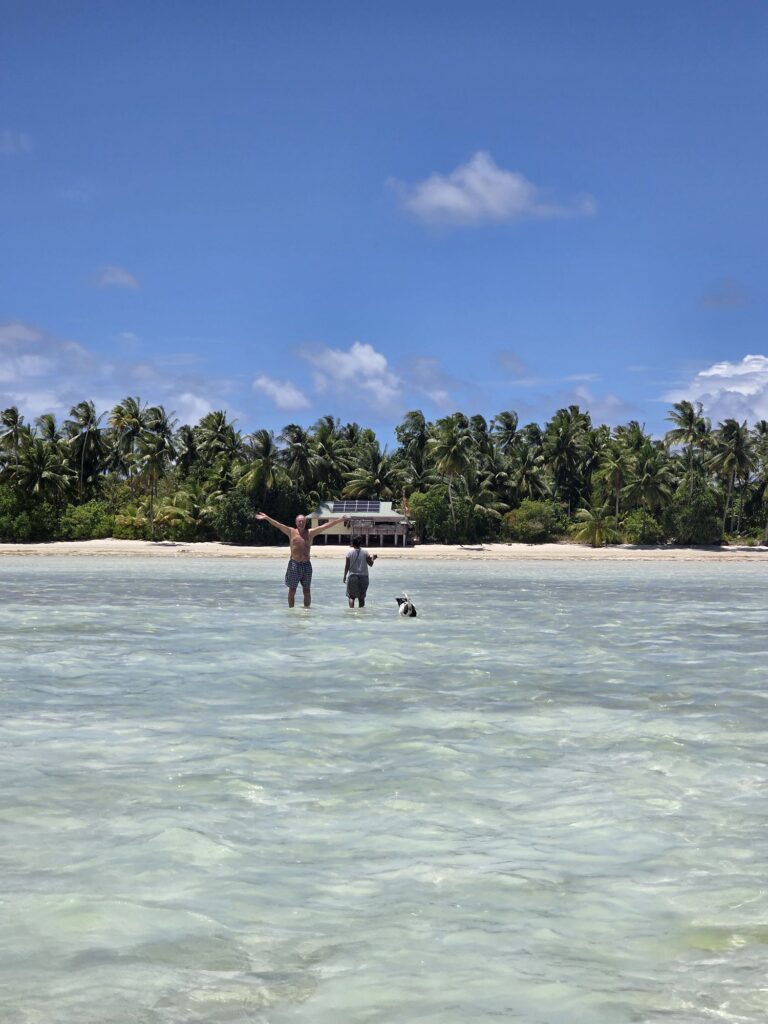
My first impression of Abaiang was: wow! A tropical island with palm trees, white beaches, and the most beautiful water you could imagine. It seemed like paradise on earth, especially when you came there directly from Betio.
KiriSwiss Residence is about a 15-minute walk, or less by bike, from where the ferry arrives. The guesthouse consists of a main building, which is right on the beach, and two cabins across the street where guests sleep. The main house has a beautiful terrace with an incredible view of the lagoon.
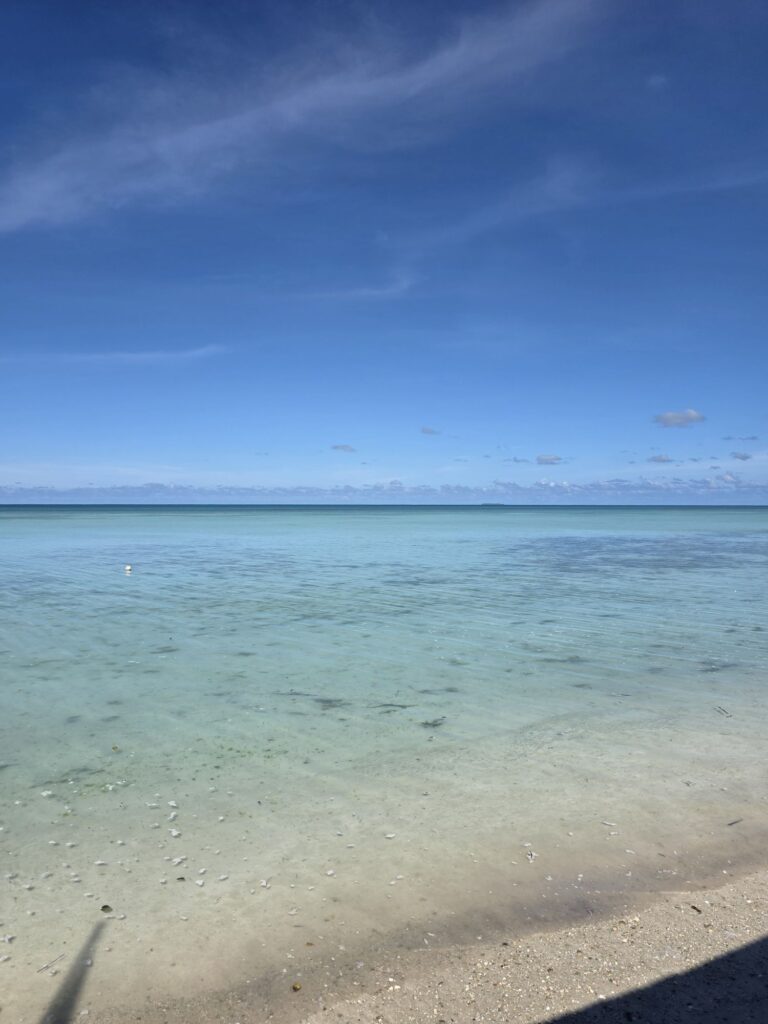
Although Abaiang is not far from Tarawa, it feels like another world. While Tarawa is densely populated, noisy, and full of traffic, Abaiang seems quiet, spacious, and more traditional. The chain of islands forms a semi-closed ring around a large, shallow lagoon. A little over 5,500 people live here.
Many villages are located directly on the water, surrounded by coconut palms and breadfruit trees, with houses made of wood, pandanus leaves, or corrugated iron. Bicycles and mopeds travel on the unpaved roads, and children play barefoot in the sand while fishermen head out onto the lagoon in their canoes.
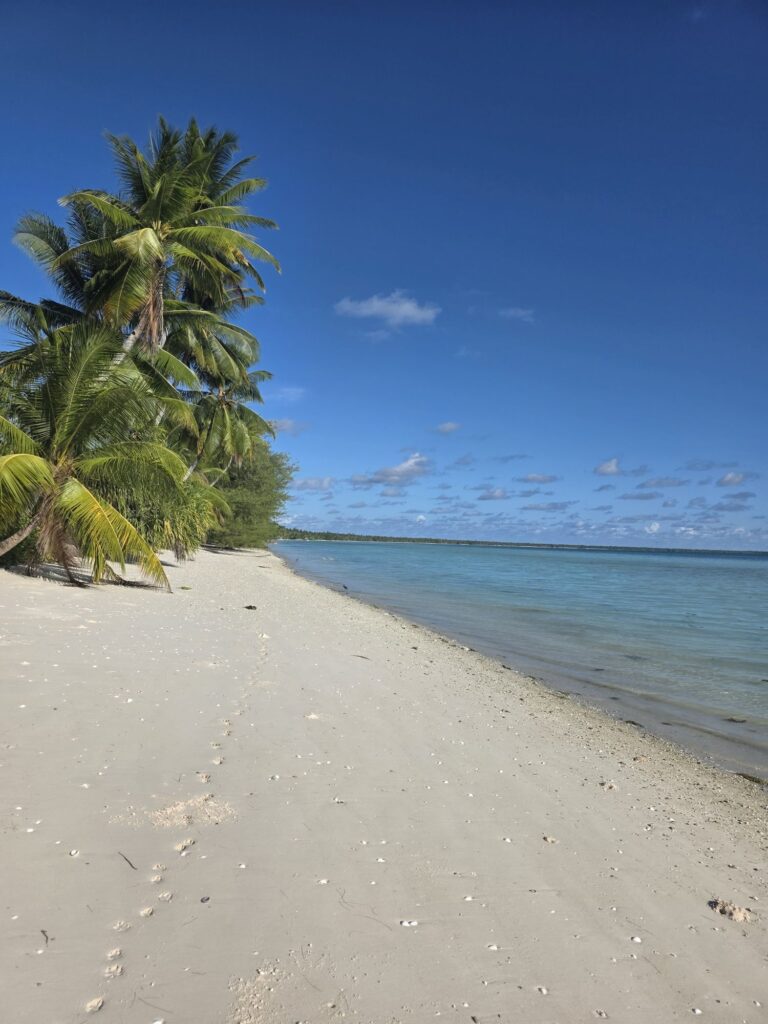
There isn’t really much to do here, but that was okay. For me, it was a much needed two-day break right in the middle of my Pacific trip. Since I still had a bad cold during those days anyway, it suited me quite well that I didn’t have many plans here.
On the second day, I took a bike and rode around the island a bit. The people here look at you with amazement; after all, this island sees very few tourists. In 2023, Kiribati recorded 8,000 tourists. I estimate that a maximum of 100-200 people make it to Abaiang.
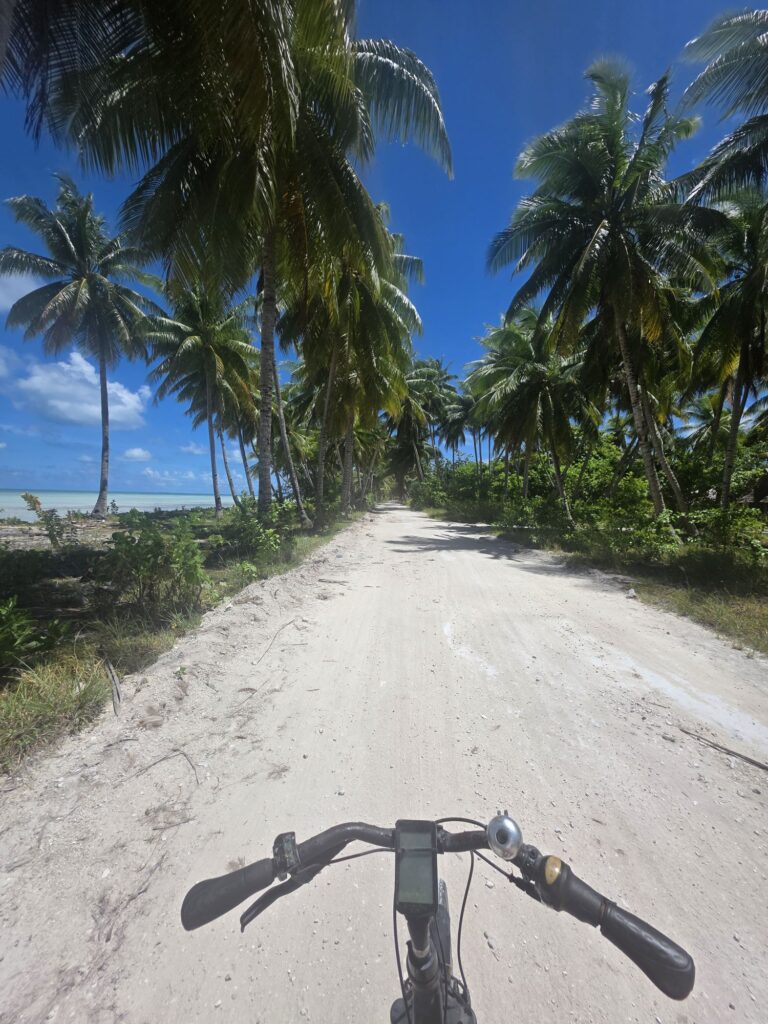
And that’s exactly what makes Abaiang so fascinating. All of the main islands in the Pacific seem very, very remote. However, the outer islands are even more extreme. Here, it really feels like the end of the world.
This is also evident from the fact that only a selection of goods is available here. I saw several small shops on my bike tour that had perhaps 20-25 products on their shelves: water, cooking oil, canned food, and a few other items. Everything you need to live, but of course never the selection you have in Tarawa (and even there, there isn’t particularly much).
Since the bike chain kept coming off every three minutes and the heat was brutal, I lost interest of my bike tour after a while. There is a cathedral somewhere that is worth seeing, Nick told me. But I skipped it and went back to KiriSwiss to swim in the sea for a while.
However, this is not possible at all times of the day. The tides are enormous here, I’ve never seen anything like it. In the morning, the sea came right up to the guesthouse. Then the tide went out and the sea receded hundreds of meters around noon. Seriously, I walked at least 10 minutes towards the horizon and was still only ankle-deep in water.
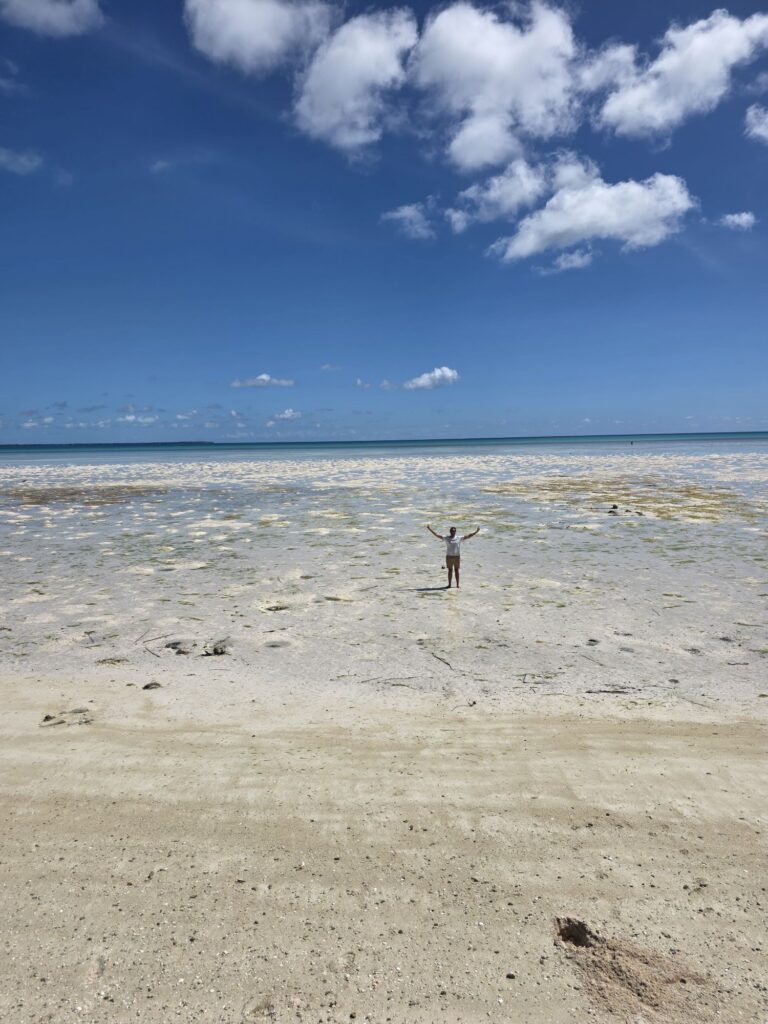
In the late afternoon, the water returned, so it was possible to swim. The water temperature was like a warm bathtub, but still a refreshment from the heat near the equator. That was my last activity before heading back to Tarawa the next day.
Day 4: back to Tarawa… or not
On my fourth and last day in Kiribati, the return trip by speedboat was scheduled for 9 am. I would then have had another afternoon in Tarawa, for which I had no real plans yet.
The next day was my departure from Kiribati to Marshall Islands. Of all the flights within the Pacific, this was the most critical, as it only operates once a week. If I missed it, my entire itinerary would have collapsed. On top of that, it was with Nauru Airlines, which had already canceled two of my flights. I’m not gonna lie, I was nervous…
On this last morning in Abaiang, I had breakfast with Nick, Lisa, and André, then I had to pack and get ready for the return trip. So the time had come to say goodbye. The two days in Abaiang were really great with excellent hosts.
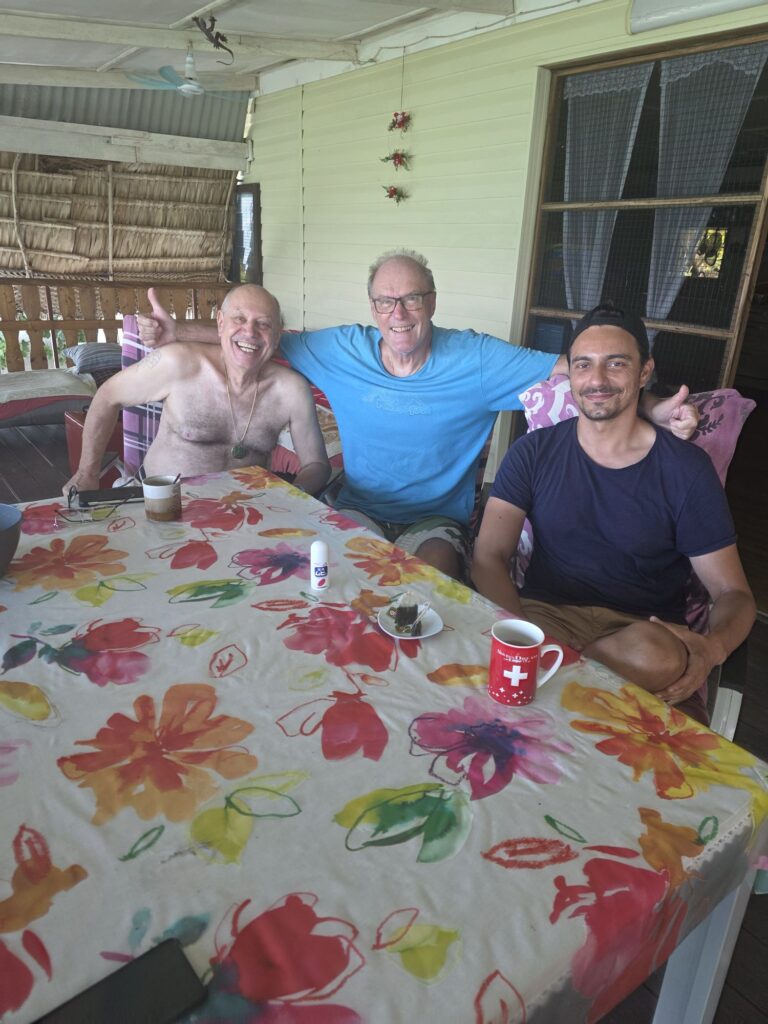
The departure time of the speedboat was again according to Kiribati time. That means 9 am was an approximate time, but it could also be 10 am or even much later. The good thing about the KiriSwiss Residence is that you have a good view of the lagoon, where you can see the arriving boat on the horizon at some point.
From that point on, you actually have about an hour to get ready, because the boat first has to arrive, unload the passengers, and load the cargo destined for Tarawa before it sets off again.
As a farewell present, Lisa gave me a te kaina, a flower wreath for my head, and a te mwenga or simply lei, a flower necklace. In Kiribati, such wreaths are often given to guests as a welcome or at celebrations. They are a sign of te Mauri, te Raoi ao te Tabomoa – life, peace, and prosperity.
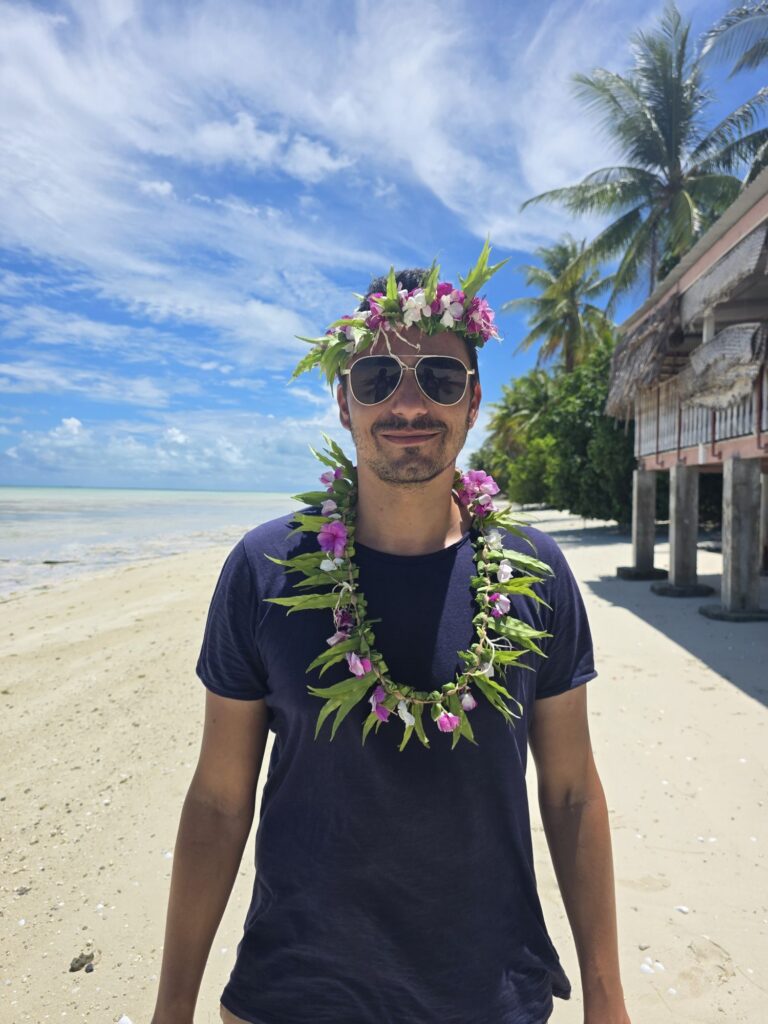
It was already 9:30 am and, as expected, the boat was nowhere. No surprise there. If someone had asked me beforehand when I expected the boat to arrive, I would have said sometime after 10:30 am.
Shortly before 10 am, Nick informed me that the boat wouldn’t come at all. Allegedly due to engine problems. Wow! Before I decided to go to Abaiang, I considered whether this would be a risk, when the return journey by boat was one day before the most critical flight in my itinerary. Nick told me at the time that the speedboat had only broken down once in all those years. I was willing to take that risk.
So what now? On the day I arrived, I had already asked Nick what to do if there was a problem with the boat. Nick said there was always a solution to this problem. However, when I heard Nick talking now, I no longer felt 100% optimistic.
Nick spent the next hour trying to clarify the situation. He asked the speedboat employee for a solution and she apparently agreed to organize a replacement boat. But I also often heard the response that there would be another boat tomorrow. I mean… great, but that wouldn’t help, because my flight was at 8 am.
I was incredibly nervous. At that moment, I thought it was idiotic to take this risk with Abaiang on such a demanding journey. I looked for alternatives to get to Marshall Islands. The solution would have been to fly back to Australia, then to Hawaii, and then to Marshall Islands. This route would have caused a three-day delay and additional costs of about $4,000.
I could hardly sit still and just wait. So I tried to actively participate in finding a solution. Together with Lisa, I walked to the nearest village to ask if anyone could take me there in a fishing boat. In fact, someone in the first village agreed. They would come to the KiriSwiss Residence at 1 pm and pick me up there.
Another problem was that there wasn’t enough fuel in Abaiang. As I said, this place is really something like the end of the world. There is nothing in abundance here, and now there didn’t seem to be enough fuel to take a boat to Tarawa. Fortunately, Nick still had about 20 liters of fuel lying around, which he could contribute. This gave the boat about 50 liters – enough for a trip to Tarawa and back.
Now it was time to wait. In a situation like this, that’s the most unpleasant thing to do. Eventually, someone came by the residence to pick up the gasoline. And at around 1 am, a boat could be seen in the distance. As the tide was already low, the boat had to dock far away from the beach.
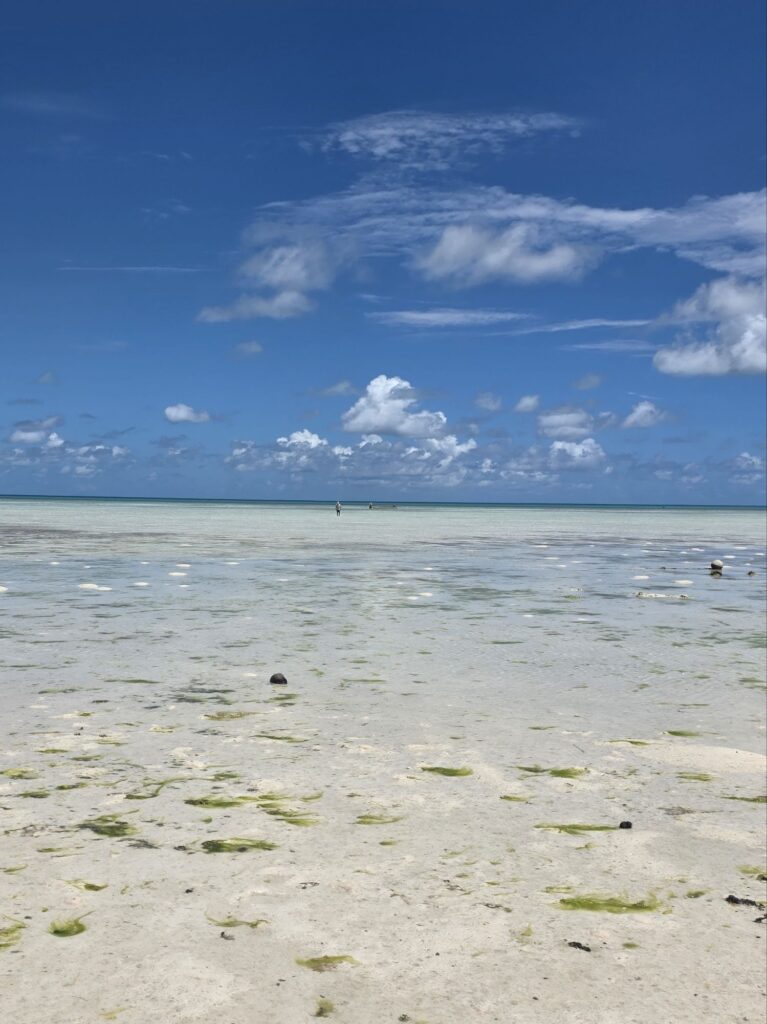
Then came the confirmation. It’s my boat! I was saved! For the last three hours, I had really come to terms with the fact that I wouldn’t be able to visit all the countries on this trip. I was so afraid of the flights, but I never expected that a boat could be my Waterloo. Those thoughts were now gone.
Due to the low tide, we had to walk hundreds of meters out into the sea with my luggage. But it wasn’t so bad and somehow part of a cool experience to end the trip. Nick was kind enough to help.
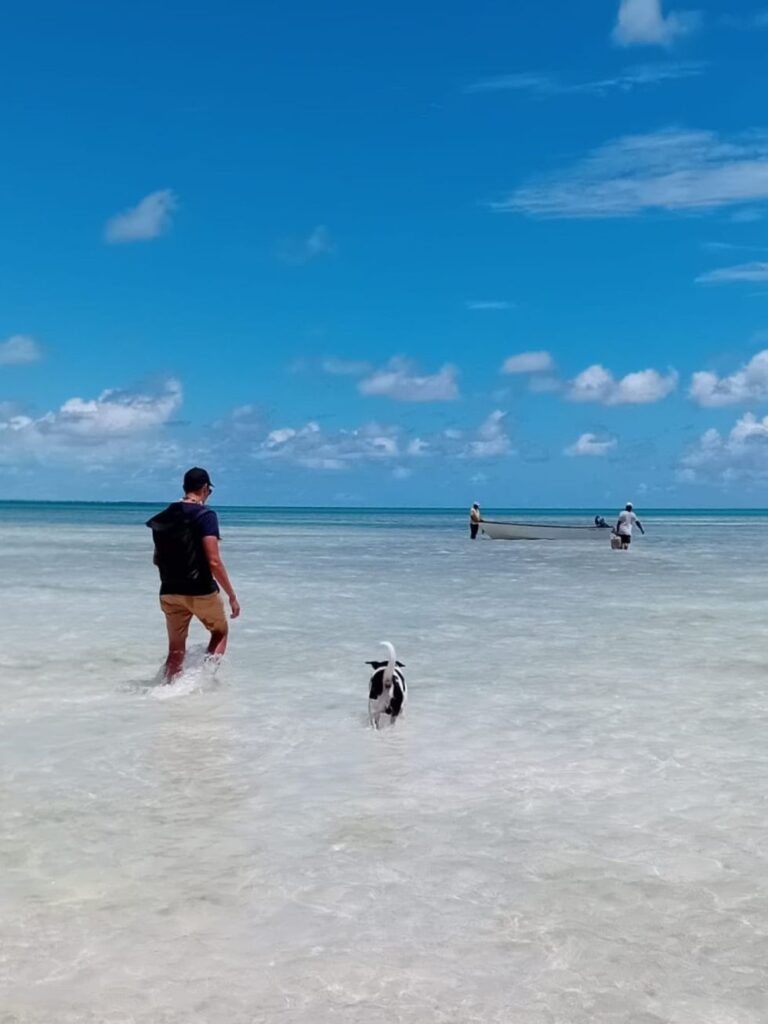
When I finally got on the boat, I knew that everything would be fine now. Two locals were there who would be traveling with me to Betio. And in case you’re wondering what this extra trip cost me? Nothing!
Nick contributed the 20 liters of gasoline. Other than that, I don’t know if they made any kind of deal. But I didn’t pay anything for this trip. Nick might have been able to collect the AUD 35 from the speedboat because it never arrived. That was probably about the value of the gasoline he donated here.
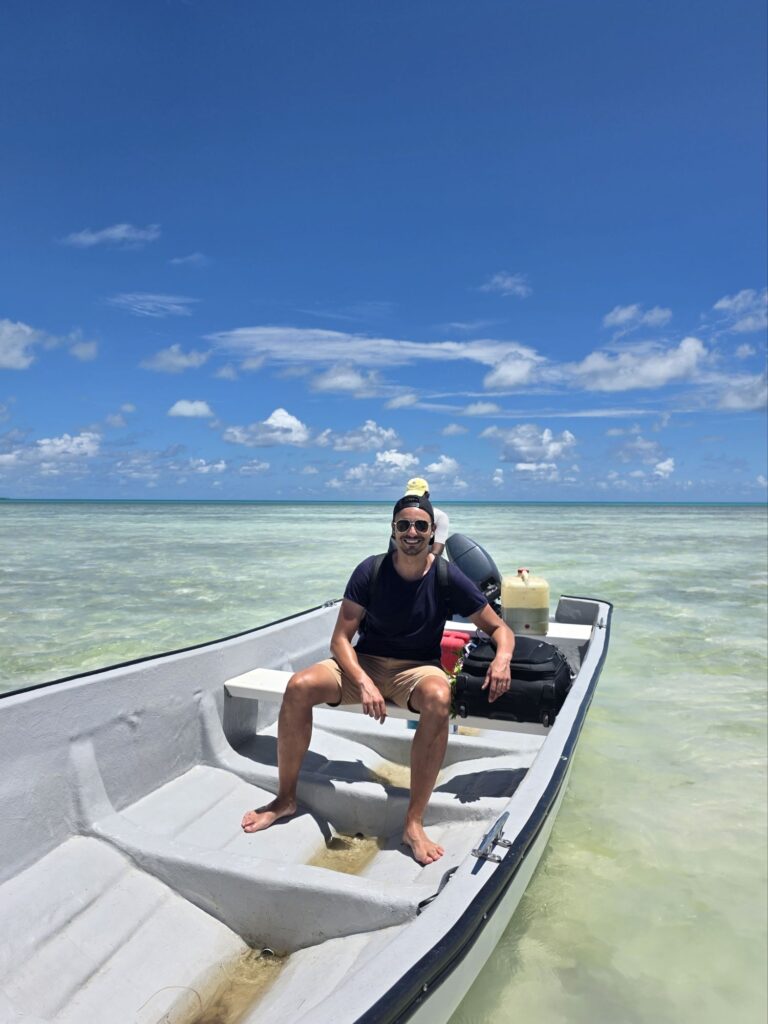
I left Abaiang with a much more dramatic story than I had actually wanted. But the main thing is that it worked out. Incidentally, the trip on the fishing boat didn’t take any longer than the speedboat, but it was so bumpy that my butt felt sore for days afterwards.
It was hard for me to say goodbye to Abaiang. This island is truly a paradise on earth – far away from civilization, if you will. For me, it was one of the most beautiful places I have seen in all the Pacific countries.
It was already shortly before 4 pm when I arrived back at the George Hotel. The day was over and I didn’t do anything else in the last few hours. Exploring Betio for another two hours was definitely not an option for me.
The next morning, I took the hotel’s shuttle to the airport at 5 am. The Nauru Airlines flight left Tarawa on time for Marshall Islands. My 194th country was now behind me, and I had also completed the most critical flight of this trip. From that moment on, it was clear to me: in a few weeks, I would have seen every country in the world!
So, how was Kiribati?
Kiribati was my 12th of 14 countries in Oceania, so I already had a good comparison with other countries in the region when I arrived in this country.
Admittedly, on my first day in Tarawa, I thought Kiribati had the potential to become my least favorite country in all of Oceania. As I mentioned earlier, I didn’t like this atoll, or Betio in particular, at all. It was kind of like “Third World meets the Pacific” in the most negative sense imaginable.
I know that may sound harsh, but that’s how I felt. Others told me that they had a good time in other places on Tarawa. North Tarawa in particular is supposed to be very idyllic. My original plan was to spend some time there before I decided to stay in Abaiang.
In retrospect, however, I am convinced that Abaiang was the better choice. This place is truly a highlight in the Pacific. I would probably describe it as the most beautiful place in the Central and South Pacific, along with Palau. So my recommendation is clear: if you have enough time, you should definitely go to Abaiang. After all, these outer islands are somehow the real deal in the Pacific, aren’t they?
My conclusion about Kiribati is therefore mixed. Tarawa was a flop, but Abaiang was great. In my personal ranking of Pacific countries, Kiribati would be somewhere in the middle. The country is definitely not geared towards tourism. The hotels are very basic, not everything works as it should… you need a certain adventurous spirit to have a good time in Kiribati!
Click here to find the trip reports of all 197 countries I have visited!
Great post, thank you! I’m going to Kiribati for (coincidentally) 4 days Oct 24-28 and this is great info, especially about Abaiang. I haven’t heard of Abaiang and it sounds like I should reach out to the Swiss guys and basically replicate your itinerary (aside from the boat problem!).
I’ve really enjoyed your blog since the 160’s. It’s not only interesting but also a great resource of on-the-ground info for some very lightly-traveled places. I’m at country #122 and might hit the 150s before I get too old (now 57). Congrats on being a few steps from the finish line!