Trip Report: Nauru
Visited in August 2025
With a delay of no less than 12.5 hours, my flight from Brisbane landed in Nauru. It was 7 am when I left the airport and entered the country. About fifteen minutes later, I was at my Airbnb, where I collapsed into bed and slept until 2:30 in the afternoon…
Nauru was my fifth-to-last country in the world and the starting point of my fourth and final trip through Oceania on my road to 197. Anyone who has been following my blog for a while will have noticed that a lot can go wrong in this region. In 2020, I spent three extra days in Tuvalu due to a cyclone. In 2022, I spent three extra days in Vanuatu due to a broken aircraft.
And so this start was certainly not what I had hoped for on this last trip through the Pacific. I have to admit that I was really nervous about this trip, which was supposed to take me to Nauru, Kiribati, the Marshall Islands, and the Federated States of Micronesia. Depending on the circumstances, a canceled flight can trigger a chain reaction and ruin the entire trip.
Imagine if I missed one country on this last trip before reaching my final one… I would have had to travel back to the other side of the world just for one country. A nightmare I didn’t even want to think about. Some travelers have had to learn this the hard way. They missed one single country due to a canceled flight.
Moreover, I didn’t really want to make this trip the second to last on my road to 197. The prospects were too risky in a region where flight cancellations and tropical cyclones are the order of the day. However, you can’t always plan exactly, after all, the trips have to be compatible with work somehow. And as a European, you can’t do a trip like this through the Pacific in 1.5 weeks.
In any case, I was lucky that the flight from Brisbane to Nauru, which had initially been canceled, ended up taking place on the same day after all. Nauru Airlines is notorious for cancellations, and I had three flights with this airline. Strictly speaking, I had five flights within the Pacific where I had to hope that everything would go well. On the first one, I got off lightly again…
The effect of this delay was that I more or less missed the first of two days in Nauru. But in a country the size of Nauru – it is the third smallest country in the world – that was no big deal. After all, I only had a program for one day, and that just took place on the second day.
Before I report on what I did in Nauru, I must mention that Nauru was one of the countries I was least looking forward to visiting. I had the feeling that this country had practically nothing to offer tourists. In addition, flights there are expensive and I needed a visa to visit – the only one of these small Pacific countries for which I needed one.
The visa has also the reputation of being difficult to obtain. There is a man in Brisbane, Mr. Cramer Cain (email: cramer.cain@brisbane.gov.nr), to whom you have to email some documents and send a fee of AUD 50. You can send him an email and he will tell you what document he needs.
Some travelers report that they received their visa three months after applying, on the day of their trip to Nauru. I was a little luckier. I sent everything about 2.5 months before the trip and received the visa five days later. It seems to be a matter of chance how quickly you get it.
Booking a hotel was almost the bigger challenge. According to Google, there are five hotels on the island. Some of the contact details are difficult to find. This is the case in many countries in the Pacific, by the way. You can find almost no hotel on Booking.com or similar sites. Even when hotels do respond, whether by email or WhatsApp, it takes a few days at best, but usually several weeks.
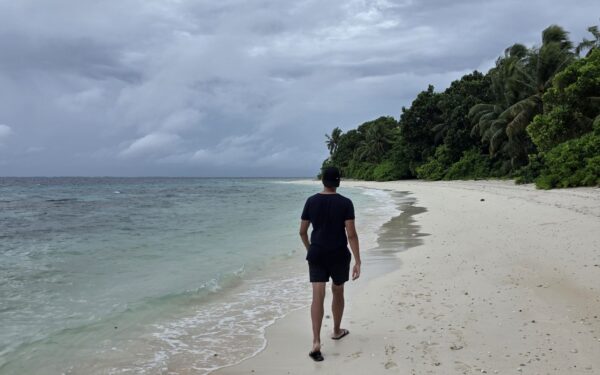
In Nauru, the hotels either didn’t respond at all or did not have rooms available. I then found the contact details for an Airbnb online that was still available. This turned out to be a stroke of luck. It was on the east side of the island, about a five-minute walk from the best restaurant on the island, the Bay Restaurant, and the best beach on the island.
These two places were what I saw in the remaining hours of my first day. The beach in Anibare was the only beautiful sandy beach I saw, so I went there in the late afternoon to cool off from the brutal heat near the equator. And the Bay Restaurant was really good, check it out if you’re ever in Nauru.
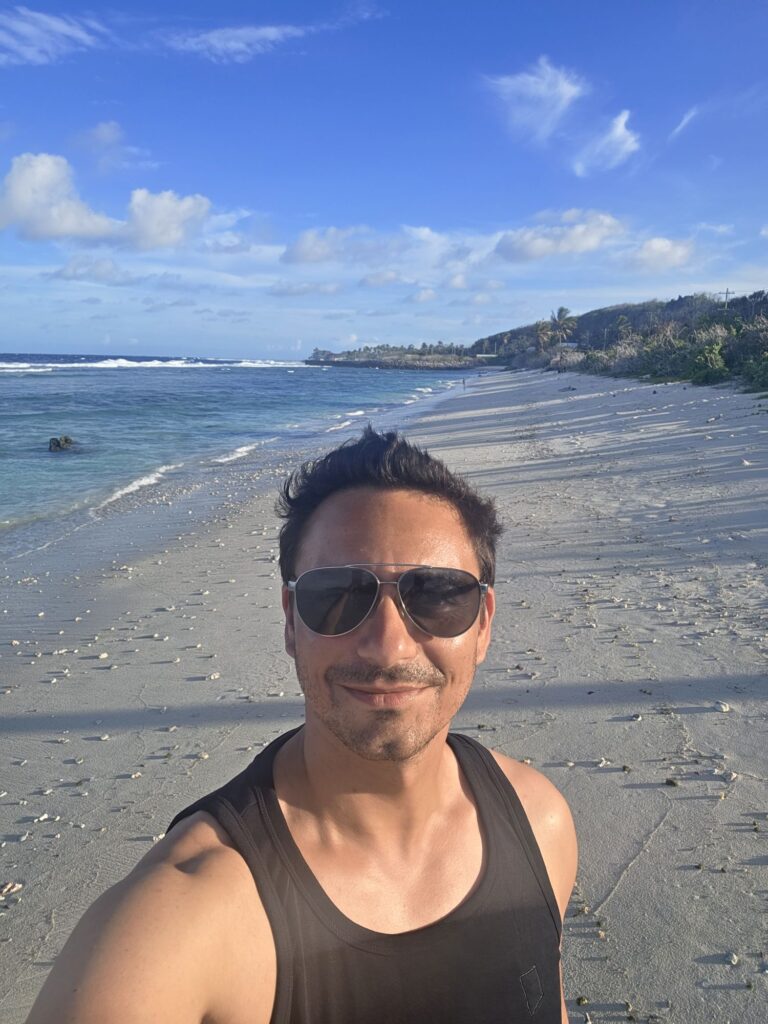
So, what kind of country is Nauru? The country is an island with about 12,000 inhabitants that can be driven around in 15 minutes. Most people have probably never heard of Nauru. And if they have, it’s the context of Australia’s asylum policy, because Nauru is home to Australia’s asylum camps. Anyone who enters Australia illegally is deported there.
As expected, the country doesn’t really have much to offer tourists. There are a few WW2 relics on the island. Many of those who travel here also take a walk around the entire island. This was also my plan for my second day in Nauru.
However, there was another challenge that day, as my evening flight out of Nauru was also canceled. My host informed me that a replacement flight was scheduled a few hours later. That was all the information I had. But this meant that I already had an unpleasant situation with my second of five flights…
I set off clockwise from my Airbnb on the east coast, equipped with a small backpack and a cap. The cap was necessary, as the heat was brutal.
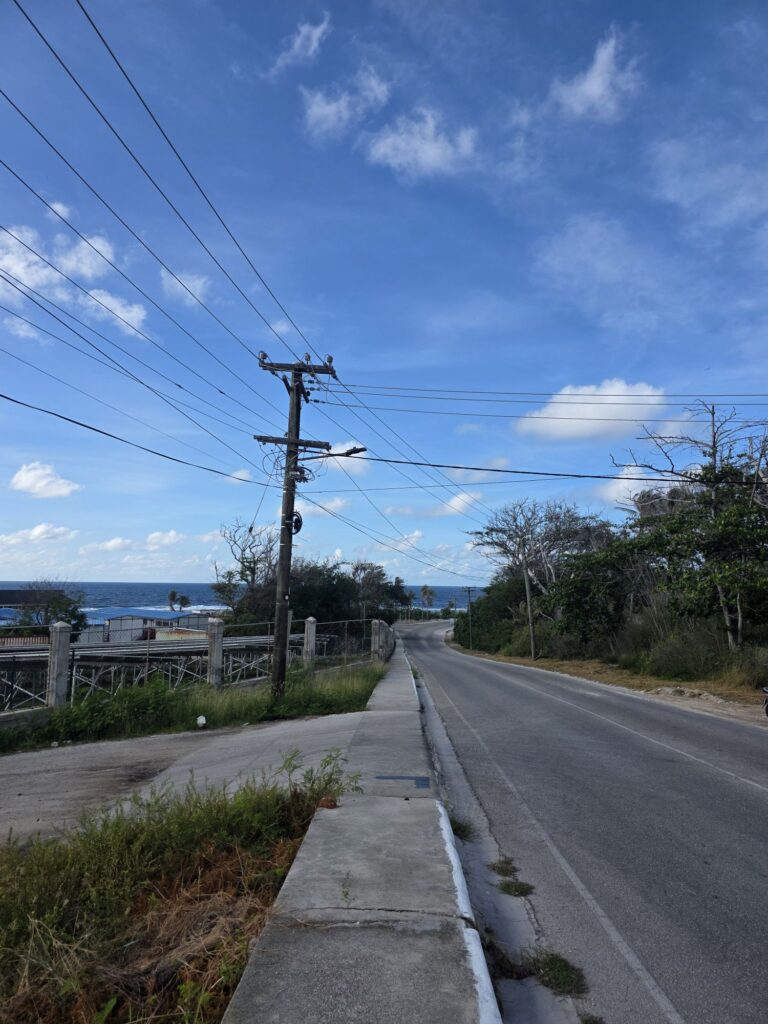
My walk took me relatively quickly past the Menen Hotel to the south side of the island. While the east side seemed rather uninhabited despite a few houses, I ended up here in a place where more people lived. So I walked past numerous small houses. The people I met were nice and greeted me.
I also saw dogs. Until recently, this was quite a problem in Nauru. Pacific countries generally have a problem with aggressive dogs, and Nauru was no exception. As a rule, these are not even stray dogs, but dogs that belong to a property and guard it.
There are numerous reports of tourists being attacked or even bitten by dogs in this region. That did not happen because they entered the property of someone. They were just walking along the street. The problem now doesn’t exist anymore in Nauru, as the owners have put the aggressive dogs on chains.
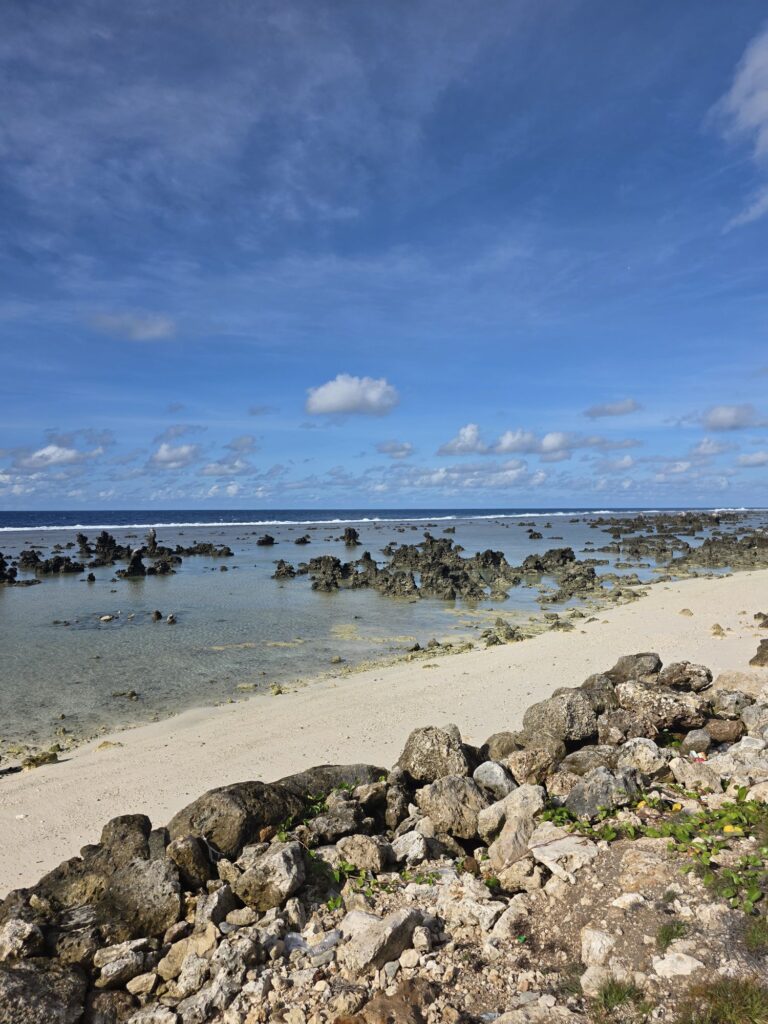
After a good hour had passed, I arrived at the airport. There, I wanted to quickly find out what was happening with my flight. “Oh, you haven’t received a notification? The flight is today at 11:40 pm instead of 8:45 pm,” the Nauru Airlines employee said to me.
Since my Airbnb host had already informed me that a new flight was scheduled for the same evening, I was never really worried. But now that I had confirmation in writing, I felt reassured. Incidentally, my Airbnb host was kind enough to let me stay in the apartment until the evening. This meant that after my tour of the island, I could take a shower and finish packing in peace.
There are a number of small shops scattered around Nauru. The Chinese run practically all of them. Apparently, China has also established itself on the island with projects, as it has on many other islands in the Pacific. I used the shops for a quick stop to buy water or other drinks and to rest for a few minutes.
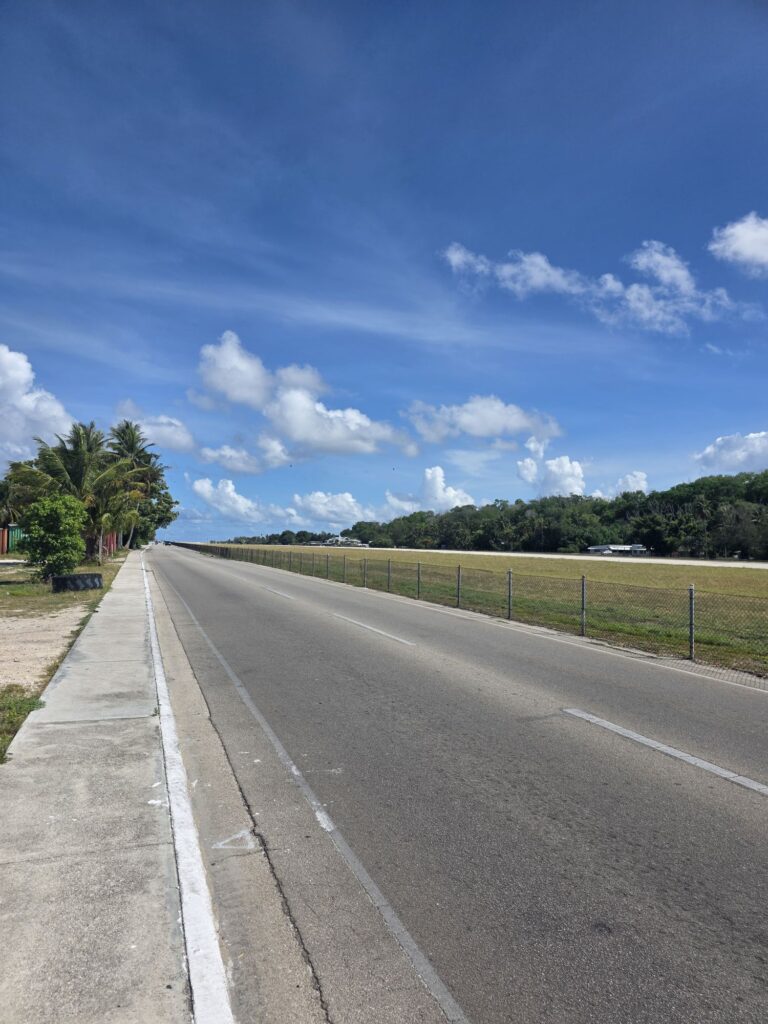
The road at the airport also took me past a former phosphate mining site. Nauru has a rather interesting history. In the 1970s, the country was one of the richest in the world, at least in terms of per capita income.
The reason for this wealth was that almost its entire land area was full of high-quality phosphate deposits, a chemical salt, and exporting them brought in enormous revenues. The small country with only a few thousand inhabitants benefited from the high global demand for phosphate as a fertilizer.
Unfortunately, Nauru was unable to manage its newfound wealth. The inhabitants were extremely wasteful with their money. According to stories, many paid with $50 bills but did not want any change back. Nauru also invested in things abroad that resulted in huge losses.
The best story is probably that of a police officer who ordered a Lamborghini to the island. Remember: it takes 15 minutes to drive around the island (at 40 km/h!). When the luxury car arrived in Nauru, he realized that he was too fat to sit behind the wheel and couldn’t even drive the car.
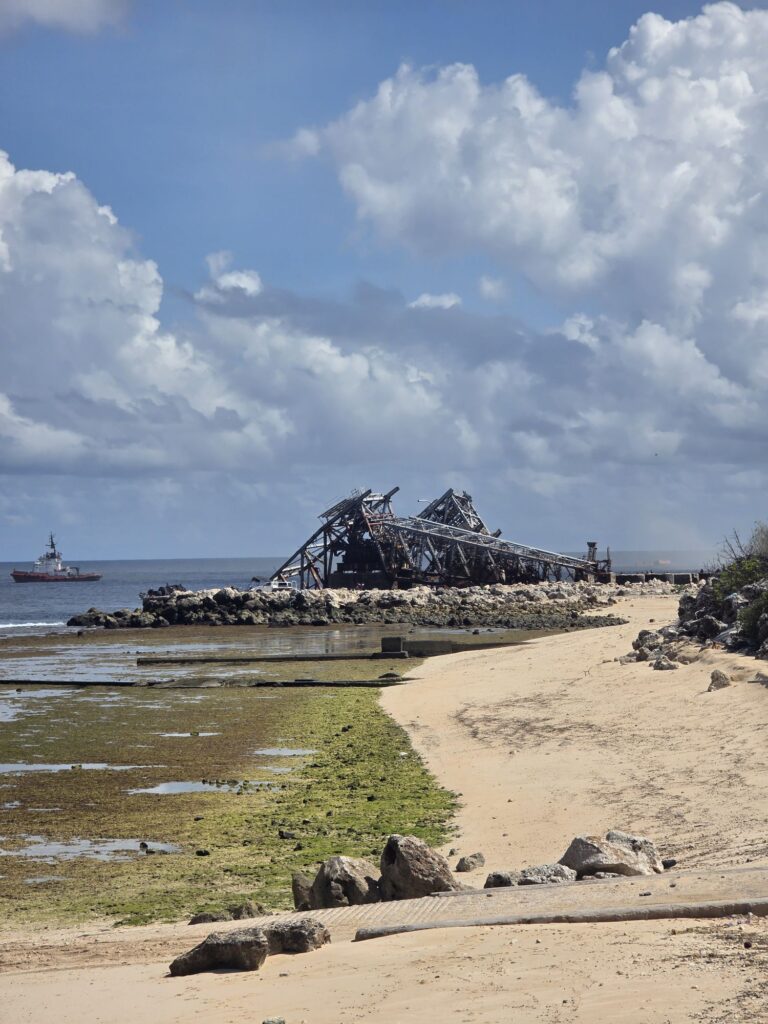
Today, Nauru is once again a poor country. A large part of its income comes from international aid money. Another part comes from the controversial refugee agreement with Australia. Nauru maintains Australia’s asylum centers. Anyone who enters Australia illegally is deported to Nauru.
About half an hour later, I saw three men in work uniforms and spoke to them briefly. They were asylum seekers from these camps. The men came from Bangladesh and ended up in Nauru after traveling illegally by boat from Indonesia to Australia.
The three men work as cleaners in a hospital and have been in Nauru for 15 months. They don’t like it here. That doesn’t surprise me, because Nauru is certainly not a good alternative to Australia. The three are waiting for Australia to decide what will happen to them.
One of them asked me to tell the world about his situation. It’s a difficult undertaking, but through my blog, at least a few hundred or maybe a thousand people will see it. Whether the three will ever end up in Australia is more than questionable, but I guess hope dies last.
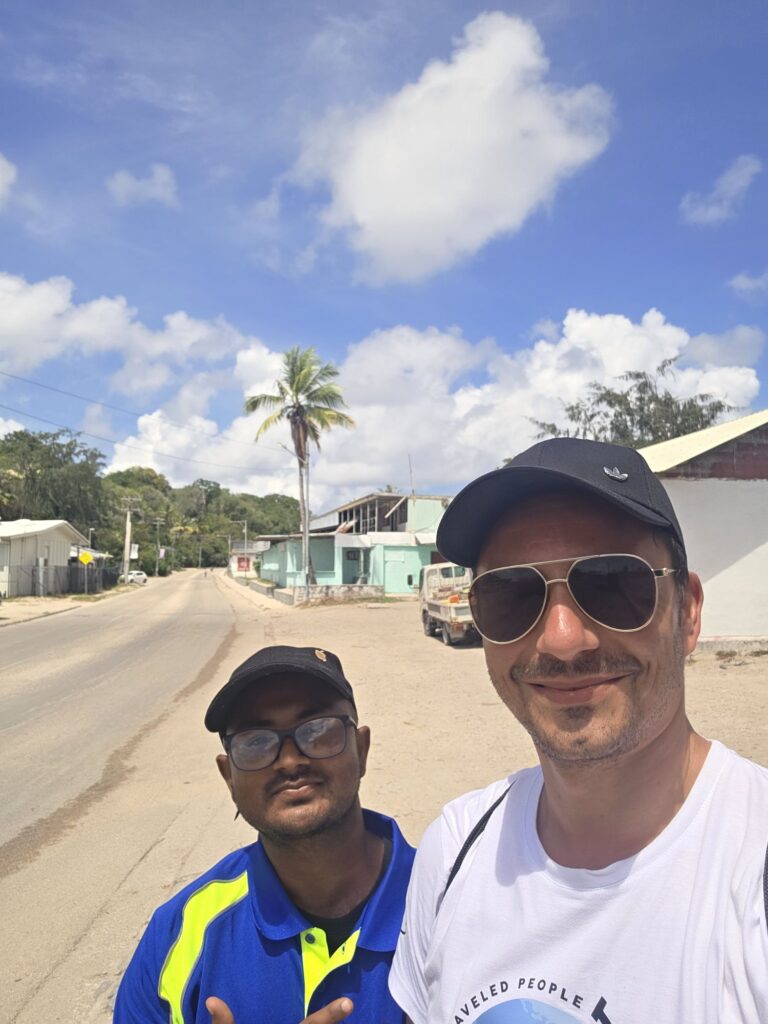
By now, I had reached the other side of the island. Walking around the island isn’t particularly strenuous, as it’s all flat. However, the sun can be a bit of a struggle. For this reason, I stopped every now and then to rest in the shade for a while.
Shortly afterwards, I arrived at the only supermarket on the island, right next to the Tropicana Café, probably the best on the island. A good opportunity to buy some snacks and drink a coffee – if you want to in this heat. This was already the north coast of the island, so I was about 3/4 of the way through.
Slowly, I was ready for the end. After about 20,000 steps, my body was longing to cool off in the sea. By the end of the day, I had taken over 25,000 steps.
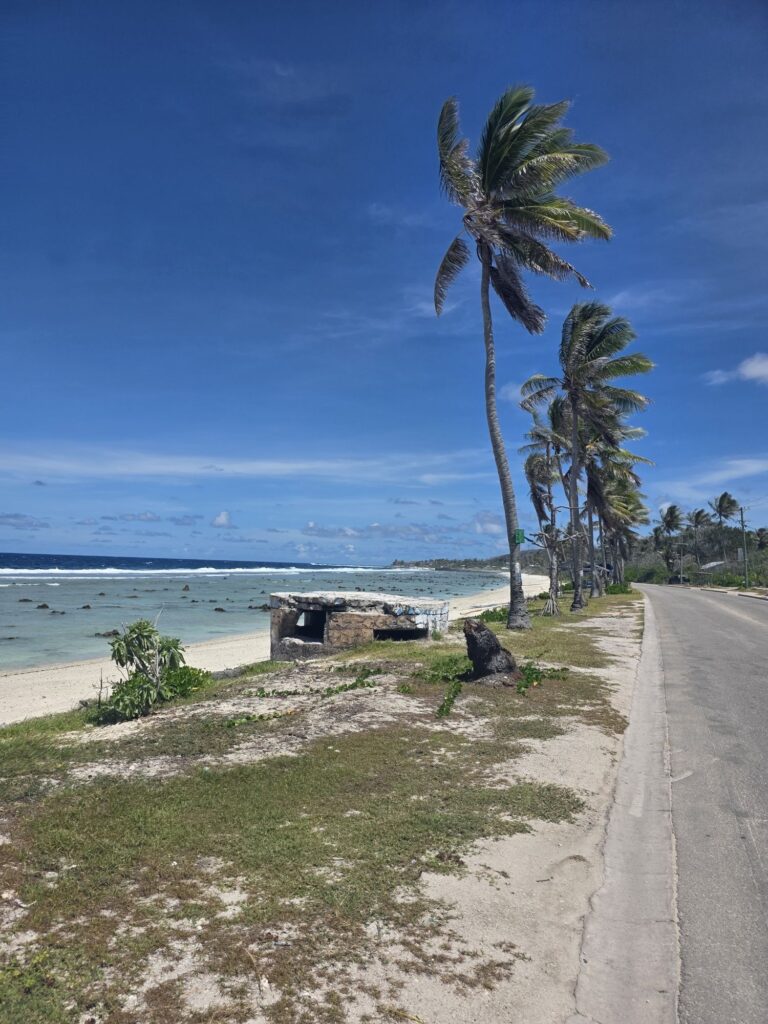
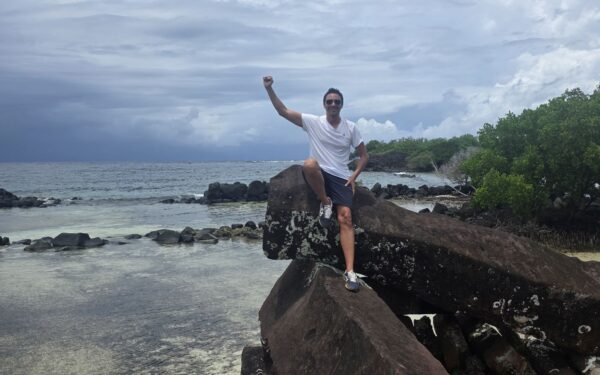
I arrived back at my Airbnb at 2:15 pm. Since I had started at 8:45 am, it had taken me 5.5 hours, with the actual walking time being around 3.5-4 hours. From that point on, I could officially claim that I had walked around an entire country.
Looking back, the walk was a cool activity. You do something for your body and see the country – not a bad combination. The only other sightseeing alternative would have been the WW2 relics. But I wasn’t particularly interested in that, so I’m actually quite happy with my choice in Nauru. There was also no need to spend money on a rental car.
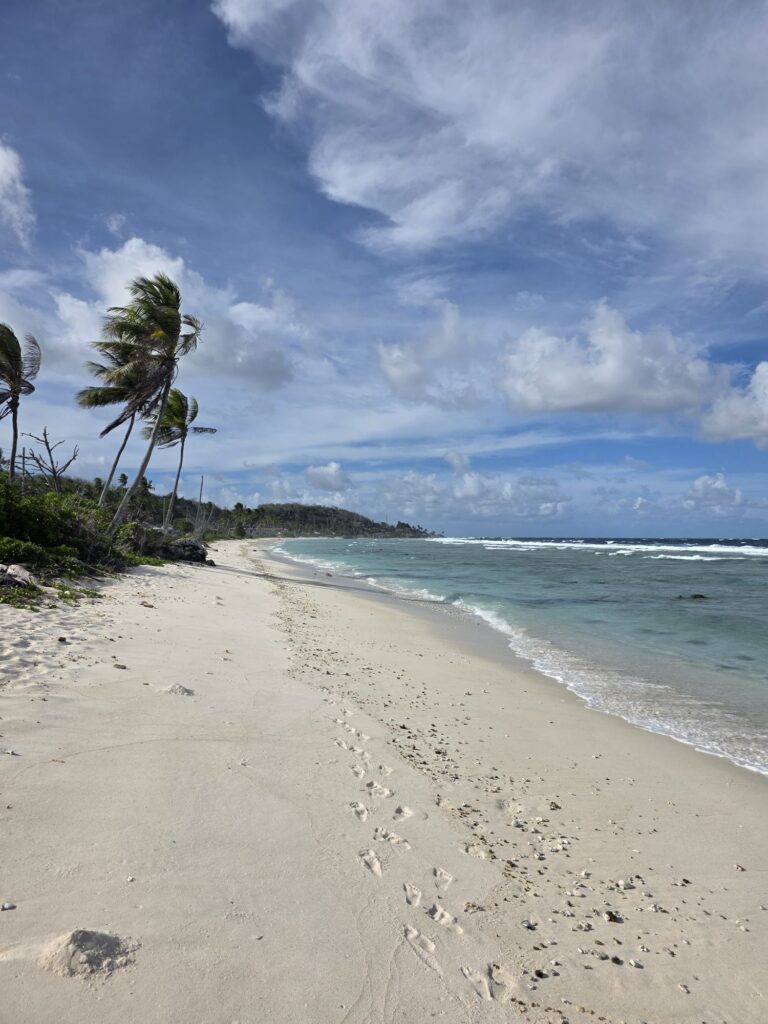
I went swimming in the sea again in the late afternoon, but this time I noticed that the sea was full of plastic debris and some sharp objects such as can lids. Maybe it was because I chose a different section of the beach, a few hundred meters away from where I was yesterday. I only mention this so as not to raise false hopes among those who imagine Nauru as a swimming destination. It is definitely not that kind of country.
In the evening, I flew on to Fiji with Nauru Airlines. The flight was delayed by another hour, so I arrived in Nadi sometime in the early hours of the morning. But at least also the second flight within the Pacific worked out.
The reason I flew to Fiji was that I didn’t want to stay in Nauru for four full days. If I had, there would have been a direct flight to Kiribati, my next destination. Before the trip, the idea of spending four days in this tiny country seemed awful to me.
In retrospect, however, it was actually quite okay in Nauru, and I could have managed the two extra days (instead of paying the approximately $600 additional cost for the Fiji layover). So, in the end, Nauru wasn’t as boring as I had imagined.
But it goes without saying that Nauru is certainly not a country you can recommend to your friends. Nauru caters to exactly the niche of travelers that I have been attracted to in recent years: those who accept the challenge of visiting the most remote countries in the world and are willing to incur costs that the country is not really worth.
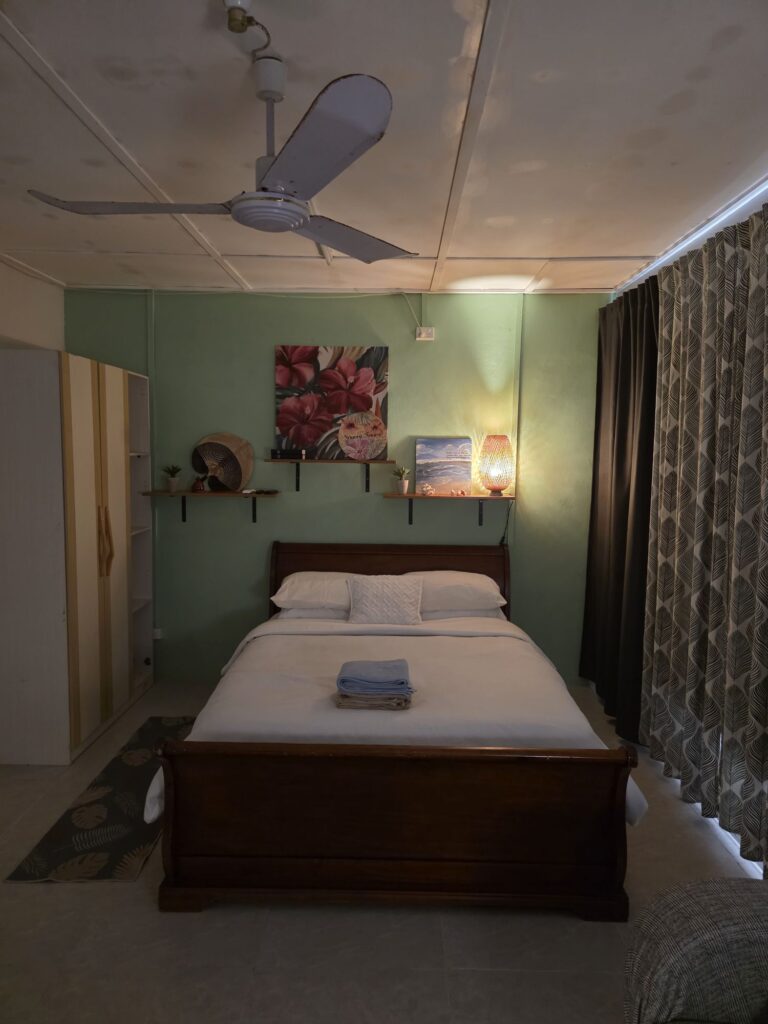
To finish this report, here’s an insider tip: the Airbnb Tinyhouse in Anibare was absolutely fantastic. I paid around $90 per night, which is comparable to hotel prices in Nauru. However, the hotels in Nauru all have a reputation for being poor, whereas I was completely happy with the Airbnb. Contact the owner, Themitra (WhatsApp: +674 556 58 29), if you would like to book there.
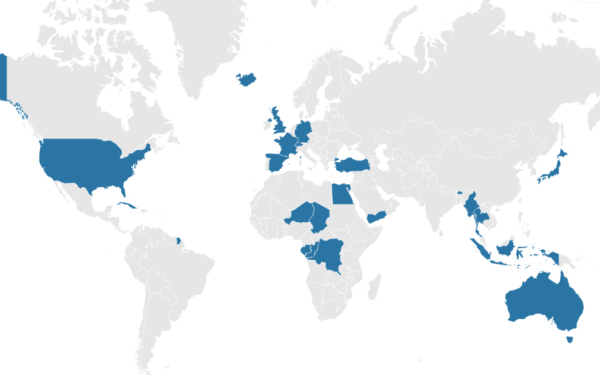
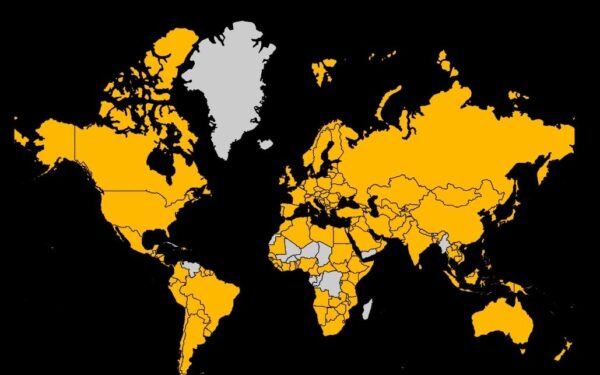
Click here to find the trip reports of all 197 countries I have visited!
Very nice report. I hope to be there in months. Thank you
Thanks for another insightful report to a country I know nothing about. Excited to see you’re heading to Kiribati (or there right now). I’m going to Kiribati in late October and looking forward to hearing your impression.
Sehr spannend 👍🏽
Your journey through the Pacific sounds both exhilarating and nerve-wracking! It’s fascinating how much planning and adaptability goes into such trips, especially in a region where cancellations and delays are so common. I can imagine the stress of potentially missing a crucial country due to a canceled flight—it’s like a traveler’s worst nightmare! It’s impressive how you managed to stay calm and push through despite the delays. Do you think you’d ever revisit Nauru to make up for the lost time, or was the experience enough to check it off your list? Also, how do you manage to balance work commitments with such ambitious travel goals? I’d love to hear more about your strategies for handling unexpected hiccups on the road.
We’ve integrated libersave into our regional voucher system. It’s amazing how easily it brings together various providers on one platform, making it a convenient tool for travelers and locals alike. Whith regards, GODZI